Table of Contents
Facility User Guides
This page gives an overview of each of the KVL user facilities and a basic user guide.
For additional questions or support, contact the KVL @ help@vis.kaust.edu.sa
Zone 1
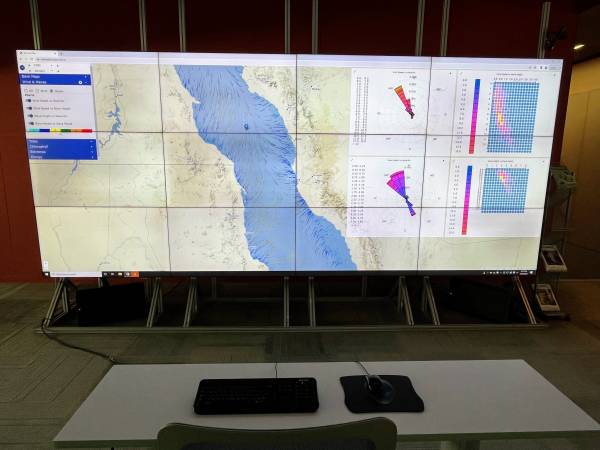
Zone 1 is a Windows OS based 2D display wall. This wall features a central operator's station, and functions just like a standard Windows desktop environment. The wall is a 4×3 planar configuration with 24 megapixels. You can find Zone 1 in Showcase (Bldg. 1, Level 2, 2304) [ how to get there ].
Zone 2

Zone 2 is a 2D display wall in a 10×4 planar configuration with 40 megapixels. The wall features several different connection methods. The backend is a Linux cluster allowing for custom distributed visualizations to be displayed, or images and videos can be shown using the installed DisplayCluster software. In addition, users can stream their own desktops to the wall through DisplayCluster using the DesktopStreamer software provided below. Lastly, the wall makes use of Cinemassive, which allows us to switch the wall to a Windows desktop environment or to a wireless display configuration, allowing users to wirelessly connect their laptops, phones, or other devices to the wall using a web browser. You can find Zone 2 in Showcase: Bldg. 1, Level 2, 2304 (how to get there).
I have Something on My Computer I need to Display, how to do this?
There are many options to accomplish this, try one of the options below.
- Copy the item to one of the computers listed here.
- Use ClickShare
- Use SAGE
- Use DesktopStreamer
- Use Remote Desktop from one of the Windows PC's listed here to connect to your system.
How do I stream content to Z2 - Tiled-Display-Wall using ClickShare?
- Select
ClickShareon the iPad - Connect one of the USB-C dongles to your device
- This works with Windows and Mac only
- The dongle will present as a CD drive. Open and run the driver.
- Connect to the Wall
- Alternatively, you can cast your screen
- This works with Windows, Mac, Android, and iOS
- Last resort (best option if trying to share a Linux screen)
- Start a zoom meeting on the iMac on the desk
- Connect the iMac to ClickShare
- Share your screen on zoom to the iMac
How do I Play Videos or Show Presentations on Z2 - Tiled-Display-Wall?
- Use One of the Connected PC's Using the iPad
- Powerwall - Windows system displaying SAGE
- Presentation - Windows system for showing presentations
- Video - Windows system for showing videos
- Mac - Mac system for showing presentations or videos
- ClickShare - Wirelessly connect your own device, See ClickShare
- Linux - Linux based system available in single or wide screen
- To upload files to any of the Windows PCs, use below link
How do I stream content to Z2 - Tiled-Display-Wall using DesktopStreamer?
- Select
Displayclusteron the iPad - Use the Mac desktop provided in the Showcase
- Launch DesktopStreamer from the desktop, select Z2, click stream
- Using a Personal Device
- Mac with M1 or later silicon: Apple Silicon DesktopStreamer
- Mac with Intel silicon: Intel Desktop Streamer
- Windows: Windows DesktopStreamer
- Linux: Linux DesktopStreamer
- Note: on Windows hosts you must add a Stream name for the connection to succeed
What is SAGE?
Smart Amplified Group Environment (SAGE) is a collaborative screen space where users can collaborate across devices and from remote locations. SAGE rooms are essentially boundless whiteboards where users can take notes, give presentations, share screens and more. All of this is then saved and can be used again later. In the KVL we use SAGE for our demo wall, which means that you can use it to view your collaborative space in large-format across our 40 screen Z2. This system is set in Wall mode, which gives a viewport to all clients, so that you know what information can be seen on the main screen. View the SAGE QuickStart guide and download SAGE to get started.
An awesome benefit of SAGE is that everyone in your group can have SAGE running and interact live with the board for collaborative meetings, discussions, and even to give presentations.
- Select
Powerwallon the iPad - Navigate to your SAGE board
KVL has their own instance of a SAGE server running on campus, meaning that anything uploaded to the server stays inside of KAUST. Simple go to: KVL SAGE Server.
- If you don't want to download the SAGE client, you can view and create boards through the internet browser.
- NOTE: Some functions may not work properly in browser
CUBES
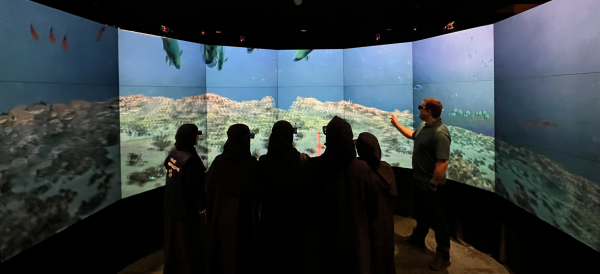
The CUBES is a semi-immersive virtual reality environment featuring a 7×3 arrangement of stereo HD panels (42 megapixels) in a semi-circle configuration. It allows for partial immersion in your data, individually, or more ideally, with a large group, which is one distinguishing featuring setting it apart from head-mounted-displays. Users can use KVL Viewer or KVL Digital Twin Platform in CUBES. Users can also run Unity applications by using the GetReal3D plugin. You can find CUBES in Bldg. 1, Level 2, 2428 (how to get there).
What kind of data can I load and visualize on CUBES?
KVL Viewer and Digital Twin Platform on CUBES supports the following:
- Images (2D and 360): PNG, JPG
- Videos (2D and 360): MP4
- Meshes: FBX, OBJ, GLTF/GLB, PLY, 3MF, DAE, 3DTZ
- Others: reach out to help@vis.kaust.edu.sa
How do I run Unity Applications on CUBES?
You can use the front-end Windows computer on the right side of CUBES to run Unity Applications built with GetReal3D.
- Turn on the screens by tapping on the control tablet (below the monitors) to turn it on, then press “Power On”.
- Run GetReal3D app launcher.
- Select the app you want to run, then click “Launch” button.
- Put on the 3D glasses (the main user should use the glasses with track-balls) and use the wand controller to navigate.
How do I load my own data on CUBES?
You can use the front-end Windows computer on the right side of CUBES to load your data on CUBES.
- Copy your data to the front-end computer.
- Follow the steps on how to run Unity Application on CUBES.
- Choose the KVL Viewer as the app to run.
- Use the data loading options in KVL Viewer to load your data directly.
AR/VR Hub

The AR/VR Hub provides augmented reality (AR) and virtual reality (VR) resources as well as powerful workstations with pen and tablet devices which are useful for manual image segmentation/annotation. These resources can be used for AR/VR demos and development, as well as for large-scale data visualization, segmentation, and analysis, e.g., using Avizo/Amira. More information about AR/VR resources can be found here.
How do I book a workstation in AR/VR Hub?
You can book a workstation using our booking webpage (book well in advance):
- Log in using your KAUST credentials.
- Check the calendar for availability of the workstation (check under AR/VR Hub bookings).
- Create a booking with a sensible Title and Purpose: mention which workstation you want to book, e.g., Workstation 1 (WS1) for Data Segmentation and Analysis.
- Click on AR/VR Hub as the Space you want to book.
- Specify the date and time you want to book.
- Click Submit Request.
- Wait for confirmation before using the facility.
How do I use an AR/VR Hub workstation?
AR/VR Hub workstations are running on Windows OS image from KAUST IT which means that:
- users can log-in using their KAUST credentials,
- KAUST IT security restrictions apply,
- remote and admin rights are not provided by default - reach out to help@vis.kaust.edu.sa if you need to install software.
How do I copy my data to an AR/VR Hub workstation?
First of all, create a folder with your username in Drive D or E (not C). Copy your data to this folder by:
- connecting your external drive to the available USB ports beside the workstation monitor,
- accessing your datawaha folder or other cloud storage solutions.
- Reach out to help@vis.kaust.edu.sa if you need assistance.
How can I use the AR/VR equipment for demos/development?
If it's your first time to use any of our AR/VR equipment, please reach out to us directly to help you set up. For your later sessions, you can book the relevant workstation using above instructions.
In addition to general guidelines for using KVL facilities, below are some specific guidelines for AR/VR Hub workstations:
- If you need to install an application that needs admin permission, send an email to help@kaust.edu.sa to request for software installation assistance.
- Do not store your data in drive C (i.e., not in your home directory in C) because drive C has limited space and can be wiped clean in case of OS failure. If other drives are available, create a folder with your username as the name of the folder and put all your data there. You can also store and back up your data in DATAWAHA, which is accessible through the workstations.
- While in the AR/VR Hub, please: keep the space clean and tidy, avoid eating/drinking in the space, do not make unnecessary noise, and only use space for official work.
- After use, make sure to: log out of Windows, back up your data, and reconnect AR/VR equipment to their charging cables.
MPR Guide
Welcome to the conference room. To ensure a smooth experience for your meeting and the teams following you, please adhere to the following guidelines:
1. Arrival & Setup (First-Time Users)
If you have never used this room before, we highly recommend a 10-minute room familiarization session before your meeting to ensure your presentation is ready to go. To arrange this, you must do one of the following:
- Add an extra 10 minutes to your initial room reservation specifically for setup.
- Submit a separate ticket requesting “room familiarization” to help@vis.kaust.edu.sa.
2. Presenting in the Room
This room is exclusively equipped with a ClickShare CX-50 Gen 2 system for presentations. The room’s camera and speakers are directly connected to this system.
How do I present using ClickShare (CX-50 Gen 2)?
Using the Provided Room Laptop (Plug & Play): - Plug the ClickShare button into the laptop's USB port. - Wait a moment for the LED ring on the button to turn solid white. - Press the button to begin sharing.
Using Your Own Laptop: If this is your first time using ClickShare on your personal device, it will not connect immediately. You must either have the ClickShare Desktop App installed, use native casting (like AirPlay, Google Cast, or Miracast), or plug in the button and open it like a USB/CD drive to run the executable file. Once the software is running and the button turns solid white, press to share.
Need more help with the CX-50 Gen 2? * Video: How to use the ClickShare Button
3. Equipment Handling
When your meeting concludes, please handle the AV equipment as follows:
- Wireless Microphones: Return all rechargeable microphones directly to their charging docks so they are fully powered for the next user.
- Room Laptop: Return the provided laptop to the podium (or its original position) and leave it powered on.
- ClickShare Buttons: You must remove the ClickShare button from the laptop (whether you used your own device or the room laptop) and leave it on the podium. Leaving the button plugged into the room laptop 24/7 causes system instability.
- Presentation Remote: Leave it on the podium.
4. Room Restoration
The room must be left exactly as you found it. Before leaving, please ensure:
- All chairs are returned to the desks/tables.
- All catering, food, and trash are cleared from the room.
- The door is completely closed behind you upon exiting.
Note: You do not need to worry about turning off the displays; our team will power off the screens remotely.