Table of Contents
Scientific Visualization 210: Introduction to In Situ Visualization
 Date
Date
- April 7, 2026
- 1:30pm - 3:30pm (2 Hours)

 Organizer
 James Kress
 Visualization Core Laboratory
 james.kress@kaust.edu.sa
 Register
Workshop Materials
- GitHub Repo: Gray-Scott Miniapp
- Docker Image: Instructions in Repo
- Slides: Slides
How to Prepare?
Required Hardware/Software:
- Bring a laptop with Docker Desktop installed.
- Intermediate Shell and Viz knowledge.
Review Prerequisite 101s:
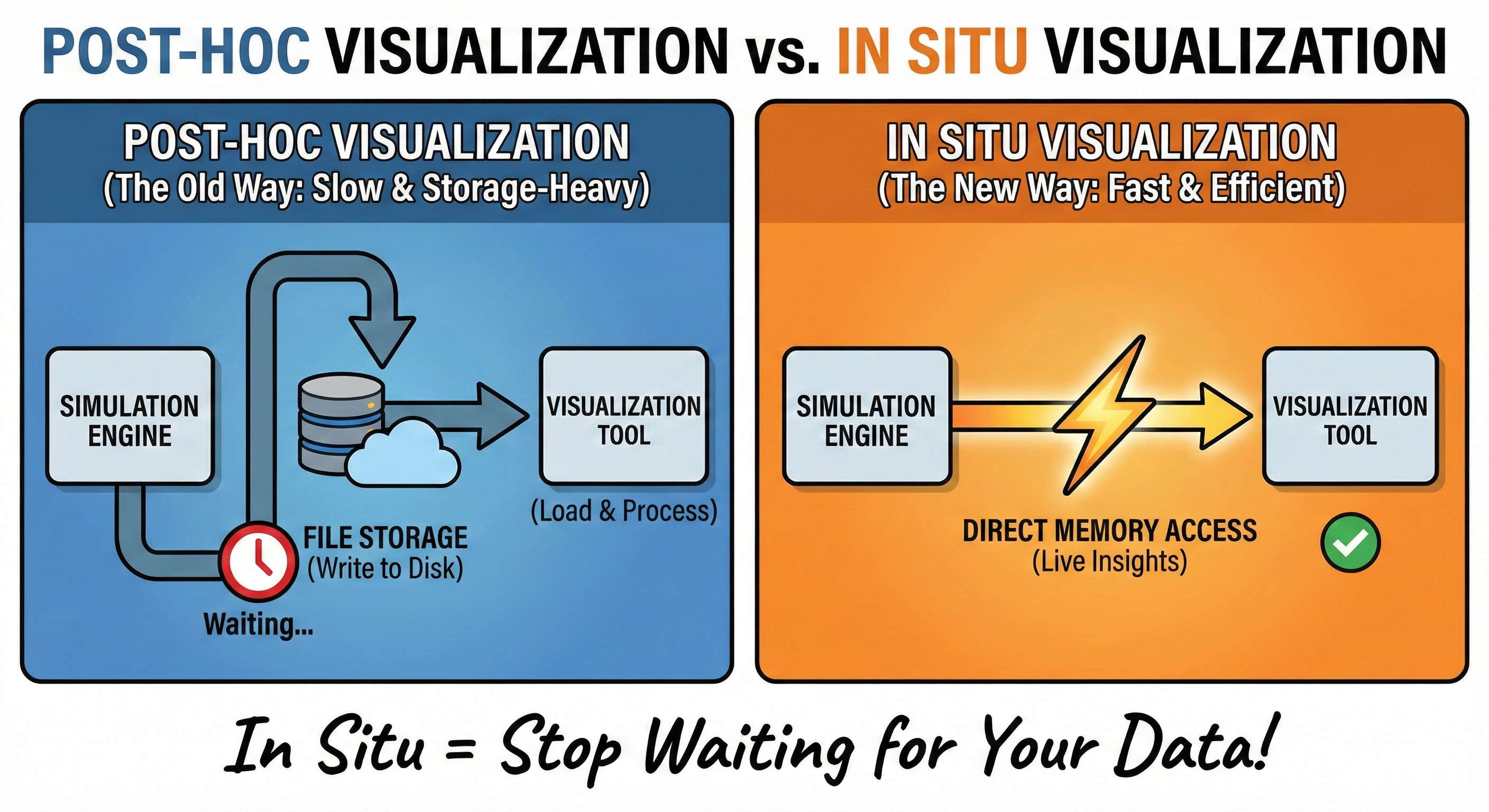
Why In Situ? Stop Waiting for Your Data!
Are you tired of waiting hours for a simulation to finish, only to find out it crashed or the output isn't what you expected? In Situ Visualization is the game-changer. Instead of writing massive files to disk and processing them later (“Post-Hoc”), In Situ allows you to “peer inside” the memory of a running simulation. It’s like live-streaming your science. By processing data while it’s still “hot” in memory, you can:
- Save 90%+ on storage costs by only saving the images or analysis you need.
- Identify errors instantly—no more wasting compute time on failed runs.
- Achieve Exascale performance—run analysis at the same scale as your simulation.
What We Will Do
This is an all-action, hands-on session. We aren't just talking about theory; we are running the code. Using a containerized Gray-Scott Reaction-Diffusion miniapp, we will spend the majority of our time in the terminal and ParaView, connecting live simulations to three powerhouse backends: ADIOS2, Catalyst, and Ascent.
Agenda
| Time | Topic | Hands-On Focus |
|---|---|---|
| 1:30pm | In Situ Introduction: Why we move analysis to the data. | Concepts |
| 1:40pm | Gray-Scott Launch: Deploying the Docker Container and writing VTK files. | Hands-on |
| 2:00pm | Break (10 Minutes) | |
| 2:10pm | Deep Dive 1: Catalyst & Ascent. | 50% Discussion / 50% Hands-on |
| 2:50pm | Break (10 Minutes) | |
| 3:00pm | Deep Dive 2: ADIOS2 and in transit in situ. | 50% Discussion / 50% Hands-on |
| 3:30pm | Scale Up & Q/A: Moving from Docker to Supercomputer. | Discussion |